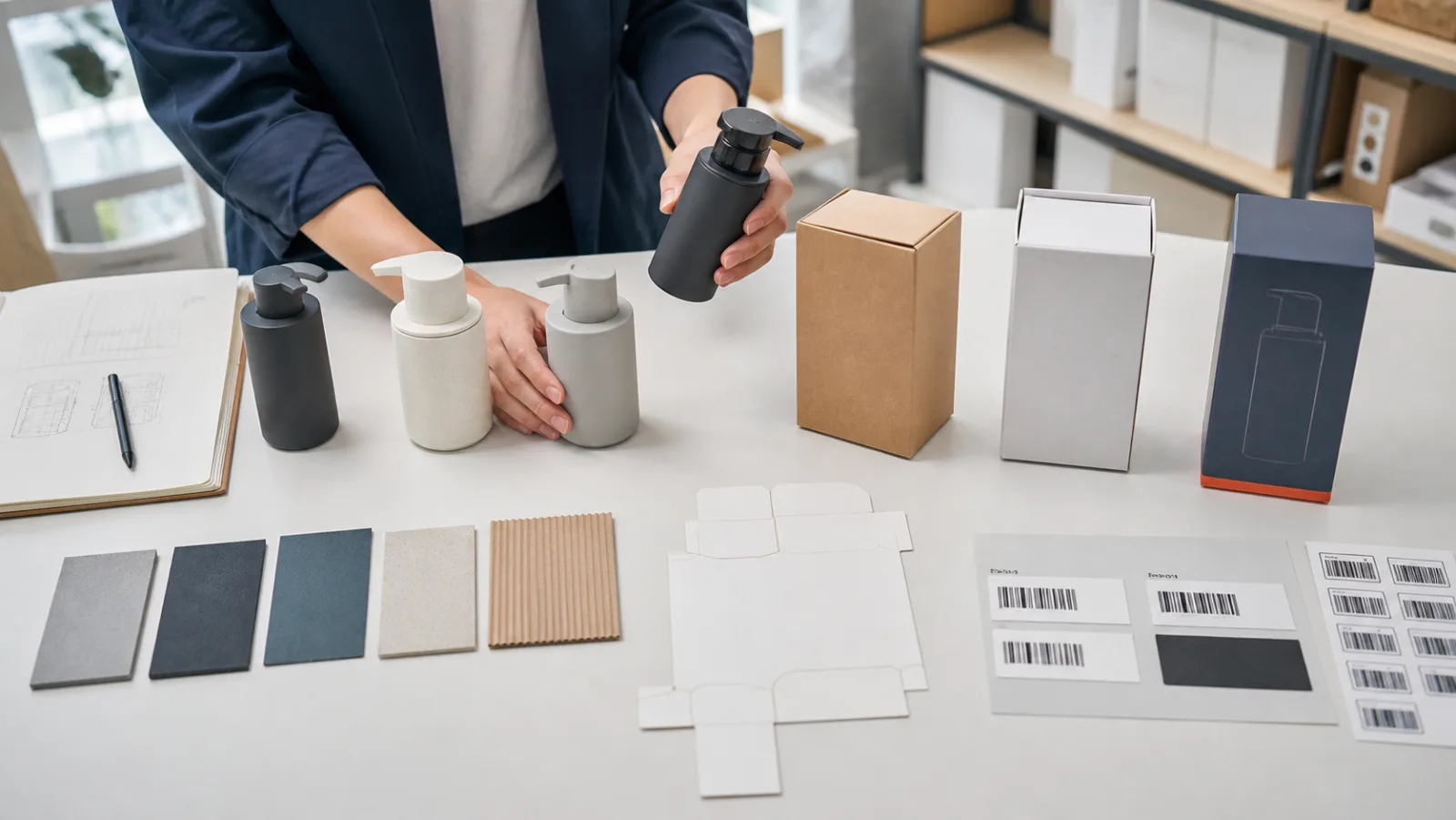
Custom packaging can improve shelf presentation and customer experience, but it can also create a higher MOQ than the product itself. For a small first order, the best packaging is usually the simplest system that protects the product, meets destination requirements, and presents the brand consistently.
Quick answer: Begin with a standard box, bag, bottle, or insert and add a custom label, sleeve, card, or stamp. Move to fully printed packaging after dimensions, sales volume, fulfillment rules, and damage performance are stable.
Define packaging in layers
Primary packaging
The container or material directly holding the product, such as a bottle, pouch, blister, or inner bag. It may affect shelf life, leakage, contamination, and regulatory requirements.
Retail or unit packaging
The box or presentation sold to the customer. It carries brand, product information, barcode, warnings, and instructions.
Shipping packaging
The master carton, dividers, cushioning, moisture protection, and pallet arrangement used to move goods safely through the supply chain.
A beautiful retail box does not compensate for a weak master carton. Treat all three layers as one system.
Low-MOQ branding options
| Option | Relative setup | Best for |
|---|---|---|
| Printed label | Low | Pilot runs, bottles, plain boxes, variant information |
| Branded insert card | Low | Instructions, story, support, cross-sell |
| Paper sleeve | Medium | Turning a stock box into a branded unit |
| One-color stamp or print | Medium | Kraft boxes and simple positioning |
| Custom printed pouch | Medium | Lightweight products where stock sizes exist |
| Fully printed custom box | Higher | Proven dimensions and repeat volume |
| Custom molded insert | Higher | Fragile or premium products with stable geometry |
Ask for the MOQ, setup charge, unit cost, lead time, and color limitations for each option. Compare total packaging spend, not just price per box.
Information to provide the supplier
- Product dimensions and weight
- Product orientation inside the package
- Fragile, liquid, sharp, magnetic, battery, food-contact, or moisture risks
- Target sales country
- Sales channel and fulfillment method
- Required barcode type and placement
- Legal product name, warnings, instructions, and responsible-party details
- Brand artwork in the requested file format
- Desired retail appearance
- Master-carton weight and size limits
Do not finalize a dieline from estimated product dimensions. Approve it using the actual production sample and all accessories.
Prototype the complete packed unit
Request a blank structural sample before printing. Check:
- Product fit and movement
- Assembly time
- Accessory and instruction placement
- Barcode scanning
- Opening and closing experience
- Protection during handling and transport
- Retail and marketplace presentation
After structural approval, review a printed proof for color, alignment, legibility, finishes, and required marks. Screens do not reproduce printed color exactly, especially on kraft board, coated paper, plastic, and textured surfaces.
Avoid hidden logistics costs
Packaging affects dimensional weight, carton count, container utilization, warehouse fees, and damage rate. A slightly smaller box can save more in freight than it adds in design cost. An overly tight box can increase damage.
Record these final values:
- Packed unit dimensions and weight
- Units per master carton
- Master-carton dimensions, gross weight, and net weight
- Cartons per pallet where applicable
- Drop or transit test result appropriate to the product
Common small-brand mistakes
- Printing a large packaging run before the product dimensions are final.
- Letting the product factory choose packaging without a written specification.
- Forgetting barcodes, warnings, importer details, or country-specific language.
- Approving artwork but not a physical packed sample.
- Using one barcode for several product variations.
- Choosing heavy or oversized presentation packaging without calculating freight.
- Ordering exactly the product quantity with no allowance for packaging setup waste or replacements.
A sensible first-order strategy
For 100 to 300 units, consider stock packaging plus a professional label and insert. Use the pilot to validate damage, customer feedback, fulfillment handling, and dimensions. Then consolidate packaging volume across repeat orders or compatible products before investing in a fully custom structure.
SourceProChina can source packaging separately, match it to the factory schedule, review physical proofs, and consolidate everything before inspection. Send us your product dimensions and order quantity for packaging options that fit the pilot stage.