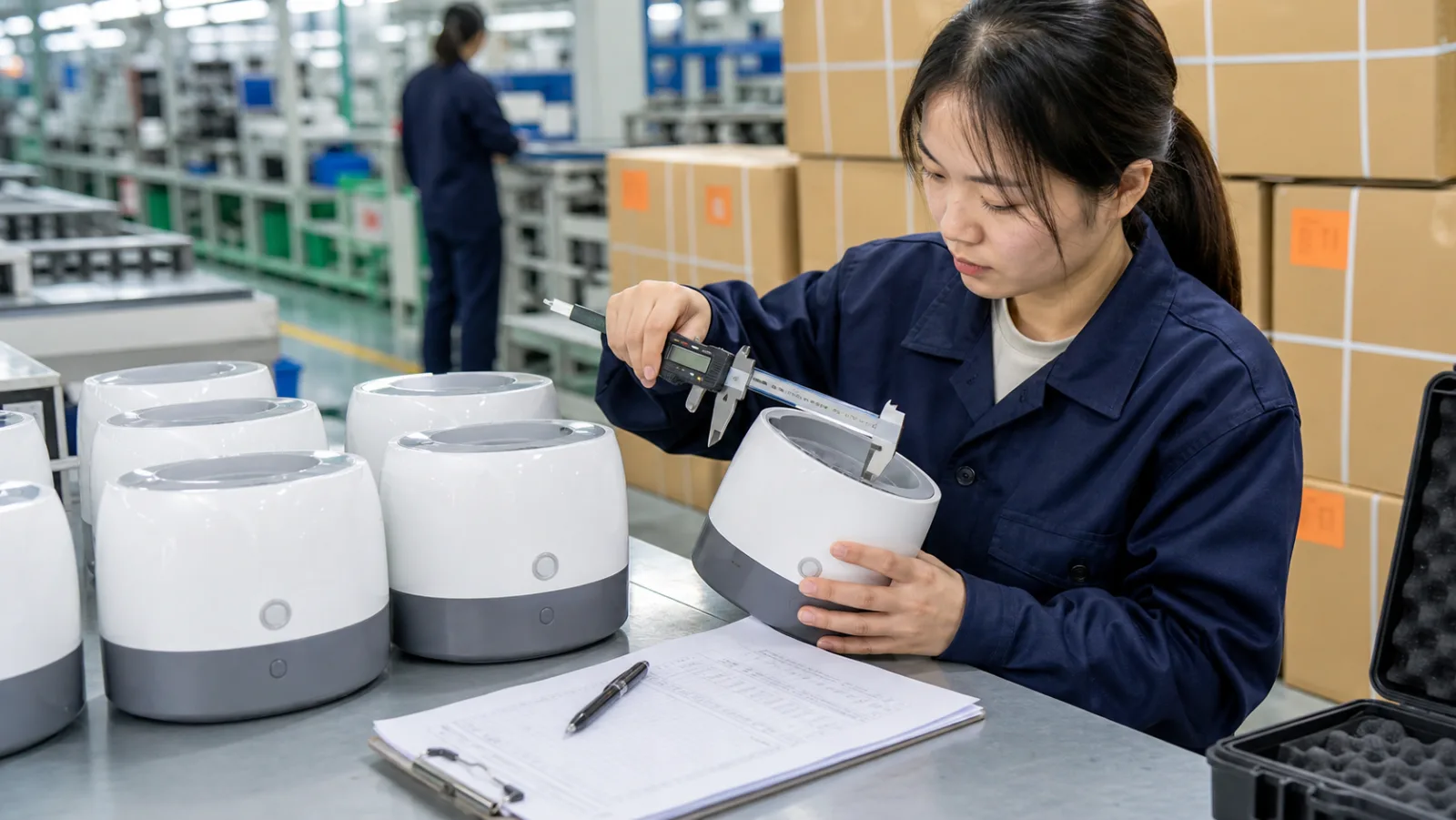
A sample can be excellent while the production order contains different materials, inconsistent assembly, incorrect labels, or weak packaging. The final balance is usually the buyer’s last meaningful commercial leverage, so inspection should happen before that leverage disappears.
Quick answer: Schedule a pre-shipment inspection when 100% of the order is produced and at least 80% is packed, before paying the final balance or authorizing shipment. The exact timing can vary, but the inspector must be able to sample finished goods and the factory must still have time to correct problems.
The main inspection stages
| Stage | Best used for | Limitation |
|---|---|---|
| Pre-production | Materials, components, setup, and specification review | Cannot prove final workmanship |
| During production | Early detection on long or complex runs | Remaining production may still vary |
| Pre-shipment | Finished quantity, workmanship, function, packaging, and labels | Serious failures can delay shipment |
| Container loading | Quantity, carton condition, loading, and seal record | Too late to remake defective goods |
For a first order, custom product, or high-risk item, use more than one control point. A pre-production meeting plus pre-shipment inspection is often more effective than relying on a single final check.
Define the standard before production
An inspector cannot enforce requirements that exist only in scattered chat messages. Build one approved specification pack containing:
- Product drawings and dimensions
- Materials and components
- Color references and finish standards
- Functional tests and expected results
- Workmanship defect definitions
- Regulatory labels and warnings
- Unit packaging and master-carton requirements
- Barcode and shipping-mark files
- Approved golden sample photographs and identifier
The purchase agreement should say which version controls and what happens after a failed inspection.
What a pre-shipment inspection should cover
Quantity and assortment
Confirm completed quantity, model mix, colors, sizes, accessories, spare parts, and carton count against the purchase order.
Workmanship
Look for defects relevant to the product: scratches, contamination, uneven seams, loose fasteners, poor fit, color variation, sharp edges, printing errors, or incomplete assembly.
Dimensions and function
Measure defined critical dimensions with suitable tools. Run the agreed functional tests rather than simply switching one display unit on.
Packaging and labels
Check retail packaging, protective material, carton strength, quantity per carton, barcodes, warnings, country-of-origin marking, shipping marks, gross weight, and carton dimensions.
Product-specific tests
These may include load, leakage, adhesion, drop, assembly, charging, runtime, temperature, or other tests. Laboratory compliance testing and production inspection are different activities; one does not replace the other.
How sampling should be handled
For mass production, inspecting every unit may be impractical. The inspection plan should define:
- Lot size
- Sample size
- Critical, major, and minor defect definitions
- Acceptance limits
- Functional-test sample size
- Any zero-tolerance safety or compliance defects
Do not select only the cartons placed at the front of the warehouse. Samples should be drawn across the finished lot. High-risk characteristics may require tighter sampling or 100% screening.
What to do after a failed inspection
Do not reduce the decision to “ship” or “cancel.” Use a controlled response:
- Review photographs, measurements, counts, and defect descriptions.
- Confirm whether the issue is isolated or systemic.
- Require a written corrective-action plan.
- Define rework, replacement, sorting, or remake responsibility.
- Reinspect the affected characteristics after correction.
- Release the balance only when the agreed disposition is complete.
A discount may make sense for a cosmetic defect that does not affect saleability. It is not an appropriate remedy for safety, compliance, identity, or critical functional failures.
Common inspection mistakes
- Inspecting before enough finished goods exist.
- Sending only a product photo instead of measurable criteria.
- Allowing the factory to choose every sample.
- Treating one passing sample as proof of the complete lot.
- Paying the balance while the report is still under review.
- Shipping failed goods based on a verbal promise to improve next time.
- Forgetting packaging, barcodes, accessories, and carton data.
Build inspection into the order, not around it
Tell the supplier about inspection before placing the order. Put the timing, access requirements, acceptance criteria, reinspection costs, and shipment authorization into the purchase terms. This turns quality control into a planned production step rather than a last-minute confrontation.
SourceProChina provides production follow-up, pre-shipment inspection, photo and video evidence, and reinspection coordination. Share your specification and shipment date to plan the right inspection stage.